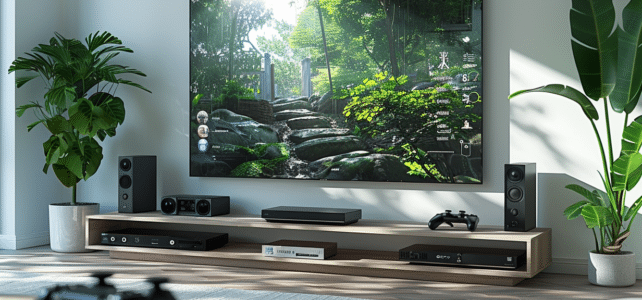
In a constantly evolving market, choosing a next-gen console can seem like a daunting task. Technological advancements and the diverse offerings from gaming giants like Sony, Microsoft, and Nintendo make the decision even more complex. The criteria for choice go beyond simple comparisons of technical specifications; they encompass the gaming ecosystem, compatibility with older titles, online services, user experience, and even the console’s design. Investing in a gaming platform is a long-term commitment that deserves careful consideration.
Choosing Your Next-Gen Console: Essential Criteria and Performance
When you opt for a next-gen console, you are entering a long-term relationship with a gaming ecosystem, services, and communities. The Microsoft Xbox Series X stands out as a powerful and quiet console, capable of delivering true 4K graphics. Priced at €499, it is the preferred choice for performance purists eager to experience cutting-edge visuals.
In contrast, the Microsoft Xbox Series S, which is more compact and priced at €299, is designed for those seeking optimal performance in Full HD. Although more accessible, it raises questions about its long-term durability, particularly for gamers considering an upgrade to higher resolutions.
For innovation enthusiasts and exclusives, the Sony PlayStation 5 is a top choice. Beyond its excellent graphics, the console features a superb controller that incorporates new forms of interaction. With a price of €549, whether it’s the PS5 Digital or Standard, players are invited to embark on a journey where backward compatibility is well-managed and the design, although massive, evokes a nostalgic old-school era.
The Nintendo Switch OLED, on the other hand, shines with its better display thanks to OLED technology and remains true to its original positioning: an ideal console for family gaming that offers unmatched portability. Available for €310, it is perfectly suited for those who enjoy social gaming and the richness of the Nintendo catalog, despite its limited graphical power compared to its competitors.

Comparison of Next-Gen Consoles: Advantages and Specifics
The Microsoft Xbox Series X comes with a significant advantage: the Xbox Game Pass, offering a wide catalog of games via subscription. This console, a direct alternative to the Sony PlayStation 5, does, however, feature a controller that, despite its proven quality, does not bring major innovations. The PlayStation 5, on the other hand, is part of a continuity dynamic with a well-managed backward compatibility and a design that is striking, oscillating between modernity and nostalgic references.
Meanwhile, the Microsoft Xbox Series S, a more affordable version of its big sister the Series X, raises doubts about its durability, especially for gamers considering intensive use over several years. Although it shares many services with the Series X, its ability to keep up with technological advancements remains an open question.
As for the Nintendo Switch OLED, it stands out with a hybrid gaming experience, combining the comfort of a home console with the portability of a handheld console. The addition of an Ethernet port is a plus for connectivity, and the Nintendo catalog, rich and beloved, continues to attract, despite its graphical power not holding up against the market leaders. It is a proposition that strays from the beaten path, offering players a different route, more focused on friendliness and accessibility.