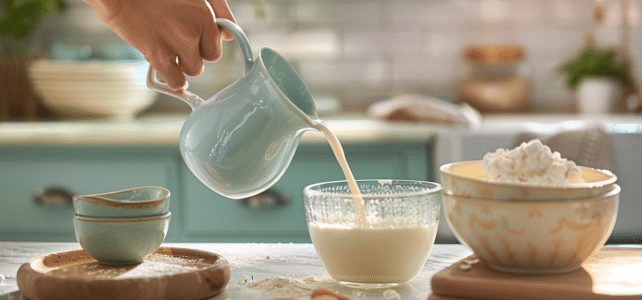
In the world of gastronomy, precision is the key to a successful recipe. Liquid measurements, vital elements of many preparations, require special attention. Often, amateur chefs find themselves faced with the need to convert small measurements into larger units to adjust quantities according to the number of guests or the size of the dish. This skill, far from being innate, is acquired and refined over time and with practice. Mastering the conversion from tablespoons to cups, from milliliters to liters, ensures the consistency of flavors and the perfect texture of dishes.
Mastering Liquid Measurement Conversions in Cooking
Knowing the units of measurement in cooking is essential for any amateur or professional cook wishing to adjust recipes accurately. Liquids, such as oils, milks, or broths, are often measured in volumes, whether in tablespoons, teaspoons, or cups. However, when it comes to making conversions, the task can become complex: converting milliliters to centiliters or liters requires a clear and precise understanding of equivalences.
The conversion chart in professional cooking is an indispensable tool for navigating between these different measurements. For example, to convert 350 ml to l, one simply refers to this chart which indicates that 1 liter equals 1000 milliliters. 350 ml represents 0.35 liters. Such a resource helps maintain the consistency of flavors and textures, ensuring the quality of the prepared dishes.
Conversions are crucial for flexibility in recipe preparation. They provide the ability to measure accurately the amount of liquid needed, whether for a simple vinaigrette or a complex sauce. The ability to juggle between measurements is therefore a valuable skill, ensuring the balance of liquid components within a recipe.
A perfect mastery of measurement conversions in cooking is a guarantee of success. It allows recipes to be adapted to all circumstances, whether to reduce or increase proportions. The conversion chart then becomes the essential ally of the cook, giving them the freedom to create without being hindered by measurement barriers.
Techniques and Tips for Successful Recipes
For professionals in the restaurant industry, measurement precision is synonymous with culinary success. Practical strategies for conversion in cooking go beyond using a conversion chart; they also involve familiarity with the metric system and the units used in other cultures, such as American recipes that use cups. Increased precision can be achieved by measuring ingredients by weight, a method often favored by chefs to ensure consistency of results.
Tips for effective conversion include using standardized measuring instruments, such as teaspoons and tablespoons, and systematically checking equivalences for temperatures, converting from Fahrenheit to Celsius. These practices ensure essential uniformity, especially when it comes to converting recipes from one measurement system to another. Conversion errors can lead to significant discrepancies in flavors and textures, thus compromising the quality of the final dish.
The importance of conversion lies in its ability to ensure consistency of culinary results, a fundamental element for any professional restaurant operator. Chefs and kitchen staff rely on precise conversion processes to adapt recipes and maintain high quality standards, regardless of quantity adjustments or ingredient variations. Mastering measurement conversions proves to be a central pillar of excellence in cooking.